discard tag allows you to use Liquid’s powerful conditional logic to make the decision not to send an email based on the state of various user and/or event properties.
Usage
A simple use case:user.first_name and if it does not match the name we are looking for, we call discard . We pass the discard tag a reason, in this case, This is not Steve. This reason will be recorded when the email gets discarded, and will show up in the logs as the Status Message on the Failure record.
NOTE: A simple property comparison like this is already possible using filters and segment conditions, and it will always be preferable and more efficient to use one of those options when possible.
What are some advanced use cases where Liquid’s conditional logic can do what it is not possible to do with filters or conditions today?
- Advanced, dynamic date comparisons
- Digging into deeply nested data structures
- Comparisons that occur after using Liquid’s powerful String or Array manipulation filters like
replace,mapand etc.
Advanced example
Dynamic date comparisons
A real world example, you have a user propertymost_recent_invoice_sent_at which is a date, formatted in iso8601 format, and you want to discard the email if the most recent invoice was sent within the last 7 days. We can accomplish this using the date_modify filter.
extra.time.now function, and format it to a standardized date format. Then we use date_modify to find the date 7 days prior and assign that to a variable, seven_days_ago. Next we assign a similarly formatted version of user.most_recent_invoice_sent to invoice_sent .
Now we compare the two dates. Remember that in computing, more recent dates are always larger than older ones.
Finally, we call discard for any invoice sent within the last seven days.
Logs
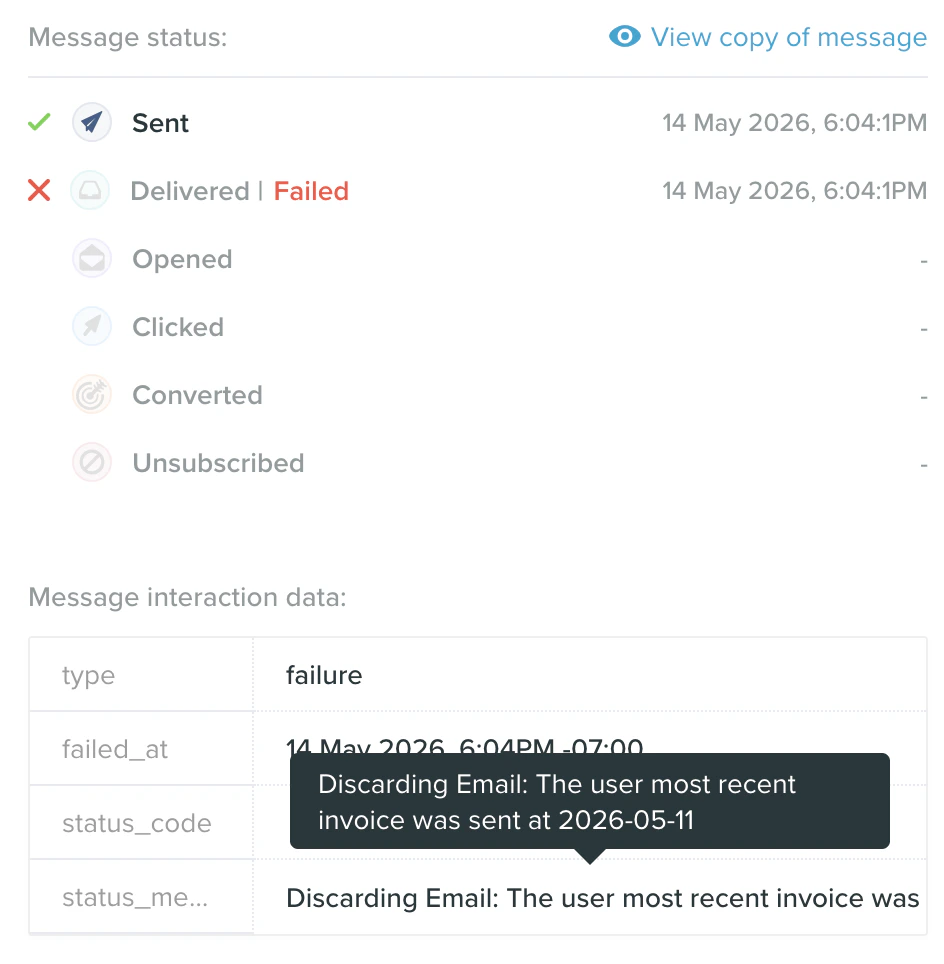
The discard will appear in the logs as a failure, with the discard reason recorded in the status message.